
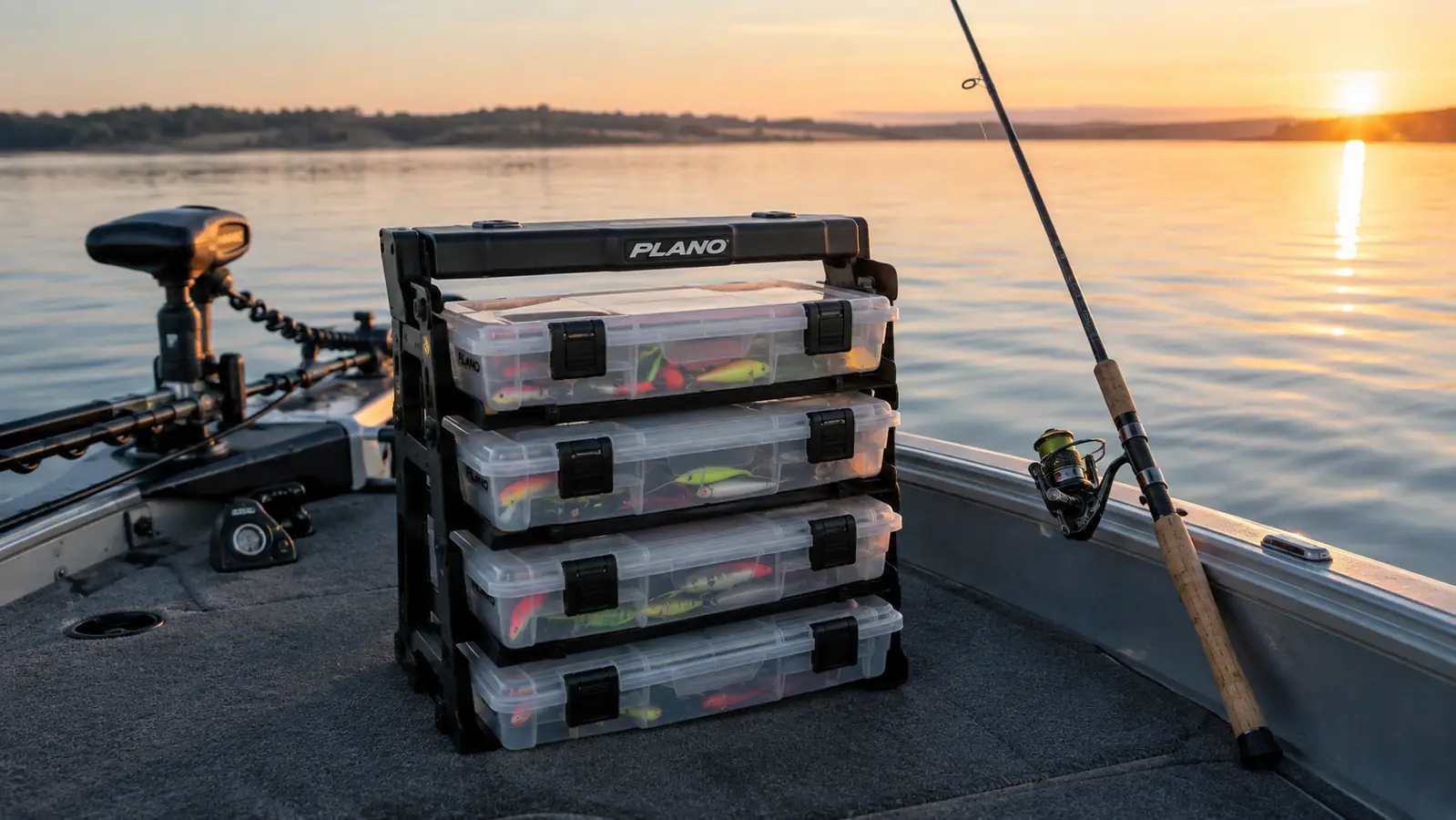
If you fish walleye and pike out of a 16-foot aluminum boat, you already know the problem. The tackle bag you carried from shore becomes a black hole the second you step onto the deck. Jig heads sink to the bottom, spinner rigs tangle around the scale, and the one crankbait that caught fish last week is buried under three pounds of soft plastics. I spent more mornings digging through that mess than I care to count, usually with the wind pushing the boat toward a rock pile while my line stayed dry. The fix was not buying more tackle. It was organizing the tackle I already own, and the Plano Guide Series StowAway 4-By Rack System is the piece that finally made it stick.
I am Cole Brandt, 51, from outside Mitchell, South Dakota. I fish the Missouri River reservoirs and the glacial lakes most weekends from April through October, and I have run the same 16-foot aluminum boat for the last nine seasons. This is the system I settled on after trying soft bags, milk crates, and a wooden box my dad built in the 1980s. It is not fancy, and that is the point.
Stop Digging for Jigs and Start Fishing
The Plano Guide Series StowAway 4-By Rack System holds four 3700 utility boxes on the deck, with quick-access top storage for the baits you reach for most. It is the rack I have used for two full seasons on the Missouri River.
Amazon Check Today's Price on Amazon →Step 1: Sort Everything You Own Into Three Piles
Before you buy a single box, dump every piece of tackle you own onto a table or the garage floor. I did this on a Saturday in early April, two weeks before the walleye opener, and it took the better part of an afternoon. Make three piles: walleye, pike, and junk. The junk pile is the hard part. Those rusty hooks, the half-empty pack of 4-inch worms from 2019, the spinnerbait with a bent wire, all of it goes in a coffee can and eventually to the trash. I filled a full coffee can that first day and my tackle was easier to manage before I bought anything new.
The walleye pile gets organized by presentation: jig heads, jig bodies, spinner rigs, crankbaits, and terminal tackle like hooks, swivels, and split shot. The pike pile gets organized by size: big spoons, big crankbaits, wire leaders, and the heavy stuff you throw when the weeds are thick. If you fish both species on the same trip, which I almost always do, you want each pile to fit into its own 3700 utility box so you can grab one box for the morning walleye bite and swap in the pike box when the sun gets high.
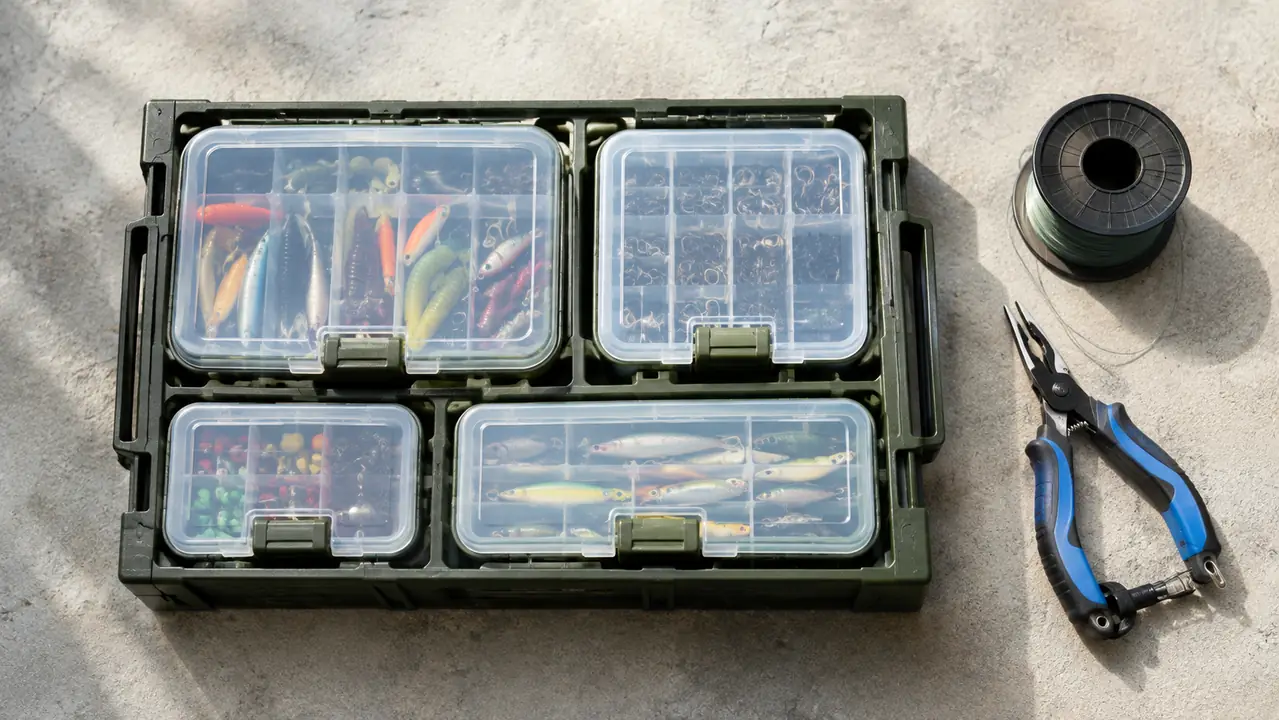
The Plano 3700 boxes are the standard size for a reason. They are about 11 inches long and 7 inches wide, with adjustable dividers, and they fit perfectly in the 4-By Rack System. I use four of them: one for walleye jigs, one for walleye spinners and crankbaits, one for pike hardware, and one for terminal tackle and tools. That is the whole system. Four boxes, one rack, no loose tackle anywhere on the boat.
Step 2: Set Up the Rack Where You Can Reach It
The 4-By Rack System mounts to a flat surface, and where you put it matters more than which brand you buy. On my 16-foot boat, the front casting deck is the right spot. I can reach it from the trolling motor seat without standing up, and it is out of the way of the middle bench where my fishing partner sits. I mounted mine with the included hardware in about twenty minutes, and I have not touched the screws since.
If you run a tiller boat like mine, think about your reach before you drill. The rack needs to be where your hand lands naturally when you are working a rod. On my boat, that is the port side of the front deck, about two feet from the trolling motor pedal. I tried it on the starboard side first, and it felt wrong every time I reached for a jig. Moving it took ten minutes and made the whole trip feel better.
The rack holds four 3700 boxes in two rows, with a quick-access top compartment under a clear DuraView lid. That top compartment is where I keep the baits I use most: a handful of 1/8-ounce jig heads, a few 3-inch paddle tails, and a couple of spinner rigs. When the bite is on, I do not want to open a box to find a jig. I want to lift the lid, grab one, and get it back in the water.
Step 3: Divide Each Box by Size and Color
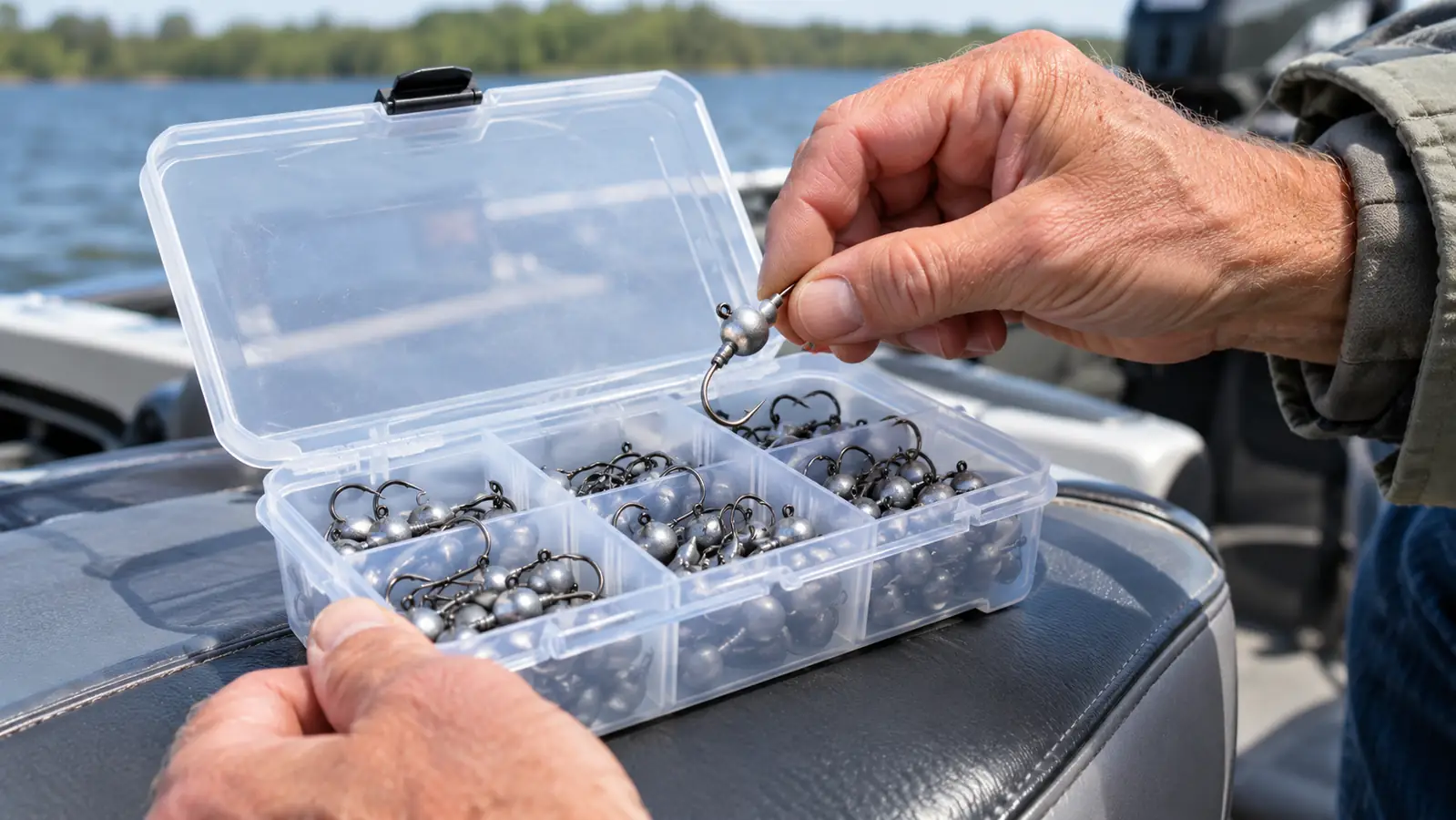
The 3700 boxes come with adjustable dividers, and this is where most people give up. They dump a bunch of jigs in a box, close the lid, and call it organized. That is not organized. That is a pile with a lid. Take the ten minutes to set the dividers so each size has its own cell. I run 1/16, 1/8, and 1/4-ounce jig heads in separate cells, with the 1/8-ounce cell getting the most room because that is what I throw 70 percent of the time on the Missouri River.
Color matters too, but you do not need forty colors. I carry four: chartreuse, white, fire tiger, and a natural perch pattern. Each color gets its own cell or its own row, so when the fish want chartreuse, I can grab a chartreuse jig without sorting through a pile of white ones. On a windy day in late May, when the walleye are on a gravel bar and the bite window is forty-five minutes, that speed is the difference between a limit and a skunk.
The same logic applies to pike gear. Big spoons go in one cell, jerkbaits in another, and wire leaders in a third. I keep a small box of 4-inch sucker minnows in the cooler, not in the rack, because they stay fresher and do not leak fish slime all over the utility boxes. That is a lesson I learned the hard way on a hot July day when the inside of my tackle box smelled like the bottom of a bait well for a month.
Step 4: Put the Boxes You Use Most on Top
The 4-By Rack System holds four boxes, but you will not use all four equally. On a typical walleye morning, I open the jig box a dozen times and the pike box zero times. So the jig box goes in the top row, closest to my right hand, and the pike box goes in the bottom row on the far side. The terminal tackle box sits in the bottom row too, because I only need it when I am retying or switching rigs.
This sounds obvious, but it took me a full season to get it right. The first year I ran the rack, I put the pike box on top because it was the biggest and looked good there. Every walleye trip meant reaching past it to get to the jig box underneath. By August I had swapped the boxes around, and the difference was immediate. The right box is the one you reach for, not the one that looks best in the rack.
If you fish alone, you can get away with one row of boxes and use the other row for storage. If you fish with a partner, give them the bottom row and keep the top row for yourself. My buddy Ron fishes with me most weekends, and he keeps his own jig box in the bottom row. That way we are not both reaching into the same box, and we are not arguing about who lost the last 1/8-ounce chartreuse jig.
Step 5: Rebuild the System Once a Month
No tackle organization system survives contact with a full season of fishing. Hooks rust, plastics melt, and the box you swore was perfect in April is a mess by July. I rebuild mine on the first Sunday of every month, usually in the garage with a cup of coffee and the radio on. It takes about thirty minutes, and it keeps the system honest.
The rebuild is simple. Pull every box out of the rack, dump the contents on the workbench, and sort back into the same piles. Throw away anything rusty, bent, or questionable. Wipe out the boxes with a damp rag. Put everything back in its cell. The whole job takes less time than you think, and it means you never step onto the boat wondering where your jigs went.
I also do a quick version of this after every trip. When I get home, I take the jig box out of the rack, rinse it with the garden hose, and set it in the sun to dry. That takes two minutes and it keeps the hooks from rusting. The Plano boxes handle the abuse fine, but the hooks inside them are only as good as the care you give them.
What Else Helps
The rack system is the center of my setup, but a few other pieces make it work better. A good pair of needle-nose pliers with a sheath stays clipped to my belt, not in the tackle box, because I do not want to dig for pliers when a pike has a treble hook in its mouth. A small hook hone lives in the top compartment of the rack, and I touch up jig hooks before every trip. A spool of 10-pound fluorocarbon and a spool of 20-pound braid ride in the bottom row for quick reties. And a dry box for my phone, keys, and wallet sits in the console, not in the rack, because the rack is for fishing tackle, not for stuff that should stay dry.
One more thing: label your boxes. A strip of masking tape and a Sharpie on the end of each 3700 box takes ten seconds and saves you from opening four boxes to find the one with the spinner rigs. I write WALLEYE JIGS, WALLEYE SPINNERS, PIKE, and TERMINAL on mine, and I can grab the right box without looking. That is the whole point of organizing tackle: less time looking, more time fishing.
The right box is the one you reach for, not the one that looks best in the rack.
Set Up Your Boat Deck the Same Way
The Plano Guide Series StowAway 4-By Rack System holds four 3700 utility boxes, keeps your most-used baits under a clear lid, and mounts to any flat surface in about twenty minutes. It has been on the front deck of my 16-footer for two seasons and it has not let me down.
Amazon Check Today's Price on Amazon →